The Devil’s Dictionary
By the one and only — Ambrose Bierce.

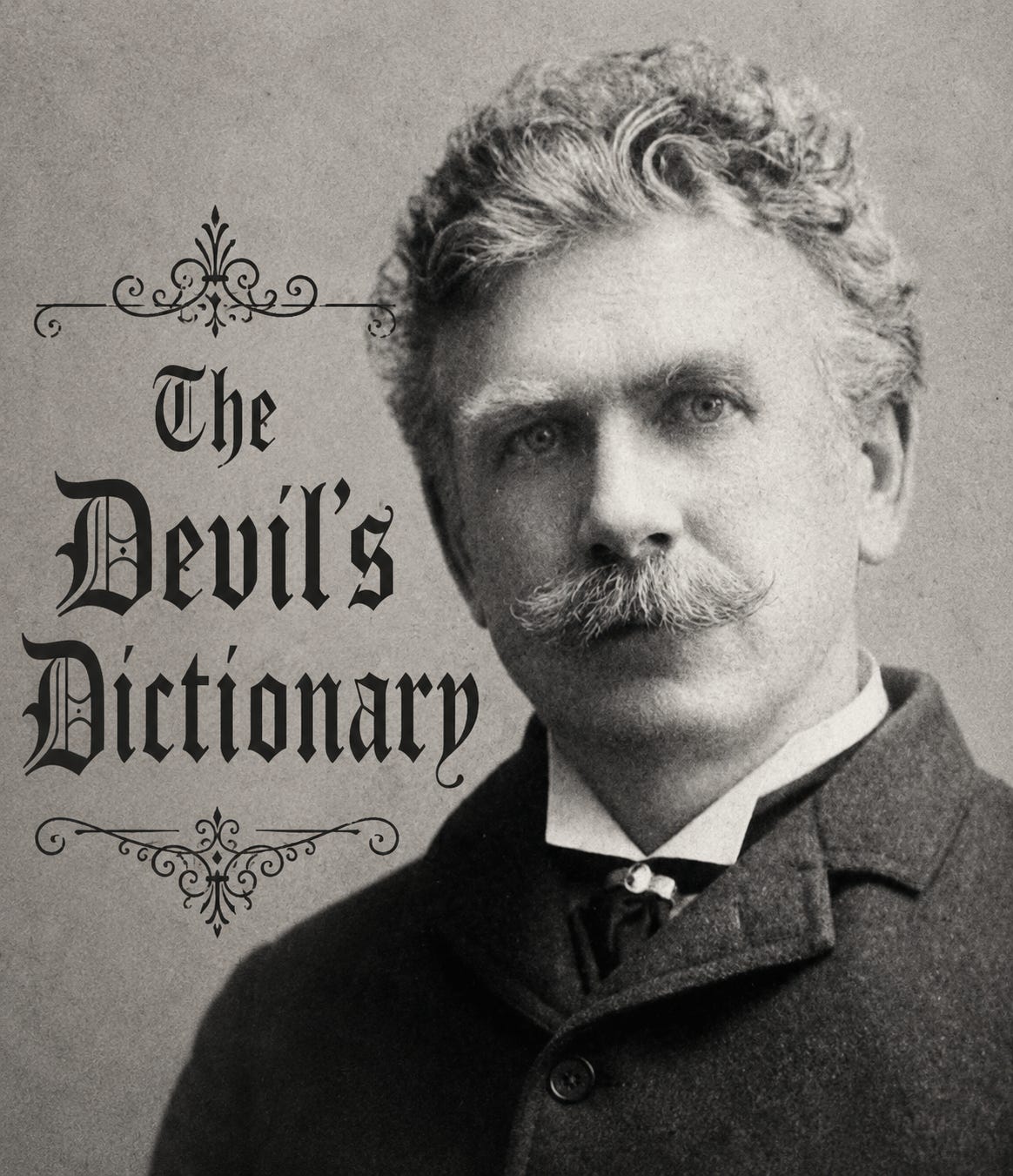
Well, I know I’m not the first, and I’m sure I won’t be the last, to write about Ambrose Bierce’s book ‘The Devil’s Dictionary’. Born in Ohio in 1842, and one of 13 children, Bierce was an American journalist, satirist, short story writer, and Civil War veteran. He is best remembered for two things:
The Devil’s Dictionary, a brilliantly cynical collection of satirical definitions.
His mysterious disappearance in Mexico, which remains one of literature’s enduring mysteries.
Having been first produced as magazine and newspaper instalments, starting as early as 1870, and published in full in 1906, Bierce’s satirical dictionary of the English language transformed “ordinary language into sharp social commentary” and, according to Project Gutenberg’s automatically generated summary, has “earned international acclaim for its brilliant, howlingly funny take on language and human nature”
I won’t dispute AI’s take on it. It’s interesting to note though, that we haven’t moved on much in 120 years .
Here, helpfully categorised for your reading pleasure, are just some of the hundreds of entries: many of which passed into ordinary parlance of the day.
His ‘definitions’ stand on their own merit and certainly do not need embellishment by this author, so I will simply quote directly from his text and leave you to add whatever you wish in the comments below.
Enjoy!
On Time
YEAR, n. A period of three hundred and sixty-five disappointments
PRESENT, n. That part of eternity dividing the domain of disappointment from the realm of hope
FUTURE, n. That period of time in which our affairs prosper, our friends are true and our happiness is assured
PAST, n. That part of Eternity with some small fraction of which we have a slight and regrettable acquaintance. A moving line called the Present parts it from an imaginary period known as the Future. These two grand divisions of Eternity, of which the one is continually effacing the other, are entirely unlike. The one is dark with sorrow and disappointment, the other bright with prosperity and joy. The Past is the region of sobs, the Future is the realm of song. In the one crouches Memory, clad in sackcloth and ashes, mumbling penitential prayer; in the sunshine of the other Hope flies with a free wing, beckoning to temples of success and bowers of ease. Yet the Past is the Future of yesterday, the Future is the Past of to-morrow. They are one — the knowledge and the dream.
On Relationships
ACQUAINTANCE, n. A person whom we know well enough to borrow from, but not well enough to lend to.
BRIDE, n. A woman with a fine prospect of happiness behind her.
FRIENDSHIP, n. A ship big enough to carry two in fair weather, but only one in foul.
LOVE, n. A temporary insanity curable by marriage
MARRIAGE, n. The state or condition of a community consisting of a master, a mistress and two slaves, making in all, two.
RUIN, v. To destroy. Specifically, to destroy a maid’s belief in the virtue of maids.
WEDDING, n. A ceremony at which two persons undertake to become one, one undertakes to become nothing, and nothing undertakes to become supportable.
YOKE, n. A word that defines the matrimonial situation with precision, point and poignancy
On The Law
APPEAL, v.t. In law, to put the dice into the box for another throw.
LITIGATION, n. A machine which you go into as a pig and come out of as a sausage.
PRECEDENT, n. In Law, a previous decision, rule or practice which, in the absence of a definite statute, has whatever force and authority a Judge may choose to give it, thereby greatly simplifying his task of doing as he pleases.
TECHNICALITY, n. In an English court a man named Home was tried for slander in having accused his neighbor of murder. His exact words were: “Sir Thomas Holt hath taken a cleaver and stricken his cook upon the head, so that one side of the head fell upon one shoulder and the other side upon the other shoulder.” The defendant was acquitted by instruction of the court, the learned judges holding that the words did not charge murder, for they did not affirm the death of the cook, that being only an inference.
TRIAL, n. A formal inquiry designed to prove and put upon record the blameless characters of judges, advocates and jurors. In order to effect this purpose it is necessary to supply a contrast in the person of one who is called the defendant, the prisoner, or the accused.
On Politics and Geo-politics
ALLIANCE, n. In international politics, the union of two thieves who have their hands so deeply inserted in each other’s pockets that they cannot separately plunder a third.
BOUNDARY, n. In political geography, an imaginary line between two nations, separating the imaginary rights of one from the imaginary rights of the other.
CAPITAL, n. The seat of misgovernment.
CONSUL, n. In American politics, a person who having failed to secure an office from the people is given one by the Administration on condition that he leave the country.
DIPLOMACY, n. The patriotic art of lying for one’s country.
PEACE, n. In international affairs, a period of cheating between two periods of fighting.
POLITICS, n. The conduct of public affairs for private advantage.
QUORUM, n. A sufficient number of members of a deliberative body to have their own way and their own way of having it. In the United States Senate a quorum consists of the chairman of the Committee on Finance and a messenger from the White House; in the House of Representatives, of the Speaker and the devil.
REVOLUTION, n. In politics, an abrupt change in the form of misgovernment.
VOTE, n. The instrument and symbol of a freeman’s power to make a fool of himself and a wreck of his country.
ULTIMATUM, n. In diplomacy, a last demand before resorting to concessions.
On Religion
CHRISTIAN, n. One who believes that the New Testament is a divinely inspired book admirably suited to the spiritual needs of his neighbor. One who follows the teachings of Christ in so far as they are not inconsistent with a life of sin.
MANNA, n. A food miraculously given to the Israelites in the wilderness. When it was no longer supplied to them, they settled down and tilled the soil, fertilizing it, as a rule, with the bodies of the original occupants.
MAYONNAISE, n. One of the sauces which serve the French in place of a state religion.
SABBATH, n. A weekly festival having its origin in the fact that God made the world in six days and was arrested on the seventh.
SAINT, n. A dead sinner revised and edited.
SATAN, n. One of the Creator’s lamentable mistakes, repented in sashcloth and axes. Being instated as an archangel, Satan made himself multifariously objectionable and was finally expelled from Heaven. Halfway in his descent he paused, bent his head in thought a moment and at last went back.
“There is one favor that I should like to ask,” said he.
“Name it.”
“Man, I understand, is about to be created. He will need laws.”
“What, wretch! you his appointed adversary, charged from the dawn of eternity with hatred of his soul — you ask for the right to make his laws?”
“Pardon; what I have to ask is that he be permitted to make them himself.”
It was so ordered.
SCARIFICATION, n. A form of penance practised by the mediaeval pious. Scarification, with other crude penances, has now been superseded by benefaction. The founding of a library or endowment of a university is said to yield to the penitent a sharper and more lasting pain than is conferred by the knife or iron, and is therefore a surer means of grace.
WORSHIP, n. A popular form of abjection, having an element of pride.
On Philosophy
LOGIC, n. The art of thinking and reasoning in strict accordance with the limitations and incapacities of the human misunderstanding. The basic of logic is the syllogism, consisting of a major and a minor premise and a conclusion — thus:
Major Premise: Sixty men can do a piece of work sixty times as quickly as one man.
Minor Premise: One man can dig a posthole in sixty seconds; therefore —
Conclusion: Sixty men can dig a posthole in one second.
This may be called the syllogism arithmetical, in which, by combining logic and mathematics, we obtain a double certainty and are twice blessed.
MONEY, n. A blessing that is of no advantage to us excepting when we part with it.
RESPONSIBILITY, n. A detachable burden easily shifted to the shoulders of God, Fate, Fortune, Luck or one’s neighbor. In the days of astrology it was customary to unload it upon a star.
TWICE, adv. Once too often.
UNDERSTANDING, n. A cerebral secretion that enables one having it to know a house from a horse by the roof on the house. Its nature and laws have been exhaustively expounded by Locke, who rode a house, and Kant, who lived in a horse.
ZEAL, n. A certain nervous disorder afflicting the young and inexperienced
On Writing and Language
PLAGIARISM, n. A literary coincidence
SERIAL, n. A literary work, usually a story that is not true, creeping through several issues of a newspaper or magazine. Frequently appended to each instalment is a “synopsis of preceding chapters” for those who have not read them, but a direr need is a synopsis of succeeding chapters for those who do not intend to read them. A synopsis of the entire work would be still better.
SLANG, n. The grunt of the human hog (Pignoramus intolerabilis) with an audible memory. The speech of one who utters with his tongue what he thinks with his ear, and feels the pride of a creator in accomplishing the feat of a parrot.
SYCOPHANT, n. One who approaches Greatness on his belly so that he may not be commanded to turn and be kicked. He is sometimes an editor.
TZETZE (or TSETSE) FLY, n. An African insect (Glossina morsitans) whose bite is commonly regarded as nature’s most efficacious remedy for insomnia, though some patients prefer that of the American novelist.
And there you have it!
And just for good measure, here are three more that I like:
ROAD, n. A strip of land along which one may pass from where it is too tiresome to be to where it is futile to go.
RIOT, n. A popular entertainment given to the military by innocent bystanders.
TELESCOPE, n. A device having a relation to the eye similar to that of the telephone to the ear, enabling distant objects to plague us with a multitude of needless details.
If you want to read the whole thing, you can find it here